One of the items near the top of my Life List (or the more pessimistic Bucket List) was to go dog sledding. There are places to do this in northern Minnesota (my home state) but I had to come all the way to Norway to accomplish it.

We docked in Kirkenes which looks like the kind of place you would see dog sleds routinely racing up and down the streets. It was a cold day, even by North Dakota standards, and gave me the chance to wear all the extra layers I had packed.
You could hear the dogs, more than 180 of them, before you could see them. I’m not sure how this enthusiastic howling went over with the guests at the Snow Hotel that was next door but maybe walls of snow and ice several feet thick block the noise.
In the cold north, this sound seems a more fitting hymn equal to the mesmerizing soprano that sang in the Arctic Cathedral for us; the dog yard was a dog-lover’s heaven with every color and variety of the Alaskan Husky howling to do only one thing, run. I had to admire that.
We were told we could cuddle any dog we wish but I was skeptical. Huskies are known be one of the more wild of the domestic dogs with some rumored to be crossed with wolves. I’ve worked in veterinary clinics and dog pounds and on the only two occasions when I experienced a dog being unapproachable, they were huskies. I never blame a dog for this; mistrust of humans seems a reasonable quality in most cases, but I give them the space they clearly ask for.
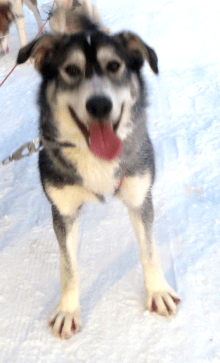
But, to a dog, these were the most friendly, cuddly, group of dogs I’ve ever come across and I’ve been to many dog shows packed with less friendly primped and fluffed show dogs. These huskies were athletes and only the admirable qualities of speed, endurance, resilience, and teamwork will get you behind the sled. Something we could all learn from.
Rita, from London, and I were going to be sledge mates. I expected to be a coddled tourist. We were shown into a room with a rack of heavy-duty snowmobile suits, Sasquatch-sized winter boots, and leather and fleece mittens the size of bear paws. My own boots and coat were very warm, but I still asked for the biggest suit they had. Very much like the dressers for Queen Elizabeth, I’m sure, it took two mushers to dress me. There were zippers on each side of the legs that had to be zipped and someone had to hoist the suit over my shoulders and pull the sleeves over my hands. I tucked my camera into a side leg pocket, put on the mammoth mittens, and waddled outside where our team of six dogs were impatiently waiting.
Lucy, our musher, is one of those fresh-faced, sparkly-eyed, young Norwegian women that grace the covers of travel brochures and Dale of Norway ads. Only she isn’t. She is from the Czech Republic, and, having only experience in training horses, she answered an ad for mushers in Kirkenes, and in a few weeks she was in Norway. It was her second season and she was loving every minute of it.

Two of the dogs were less than two years old and yipped with excitement at yet another chance to pull cruise ship buffet-fed tourists through the countryside. Two of the dogs were older with expressions that said, Here we go again pulling tourists through the countryside but if it means I can run, I’m all for it. I had to pet all of them and every dog was obliging but still had only one thing on her mind, to run.
I expected to be strapped in with seat belts, possibly helmeted with a very non-traditional bicycle helmet, and quite possibly given a safety lecture by mushers motioning like flight attendants. Blankets had been mentioned and offered, so I pictured Rita and I comfortably bundled into the sledge like pampered Victorians on a Christmas sleigh.
To their great credit, we were not.
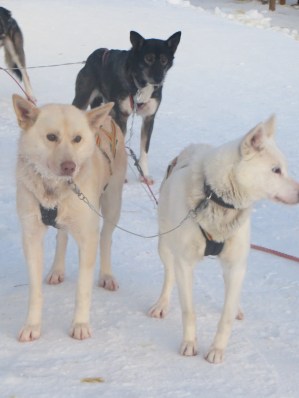
The instructions seemed simple enough: Sit on the sledge (there was one layer of reindeer skin for comfort), put your feet here (not near the runners), and keep your hands in (to avoid being snagged off a sledge by a passing branch).
Rita offered to sit in the back after adjusting five layers of neck and face protection, so she could continue to breathe which is always preferable. With our arms sticking out from our bodies for balance and the wind suits stiff around our middles, the technique was to take a deep breath and swing your leg over the sledge and fall to the seat as gracefully as possible. There wouldn’t be a second chance. A miss meant an ungainly tumble to the snow, in which case a team of mushers would be needed to set us upright again.
I will say though, in the photos, I do fancy myself looking like a true arctic explorer.
Once seated, I waited for the strapping in. The sledges are the Ferrari of sleds, as spindly as racing bikes, but tough and flexible. Where Lucy told me to place my feet was on just a very thin, maybe two-inch wide, rail of wear-polished wood. I tucked my elbows and hands in and waited for the straps, thinking I would be tied up like a load of flour to be hoisted on a cargo ship. I didn’t want to lean back into Rita because our layers of warmth were suffocating enough.
No straps. Nothing. Just the hope your butt stays stuck to the reindeer skins, you keep your balance, and you manage to somehow grip the smooth wood which is akin to holding a hockey stick with your foot.
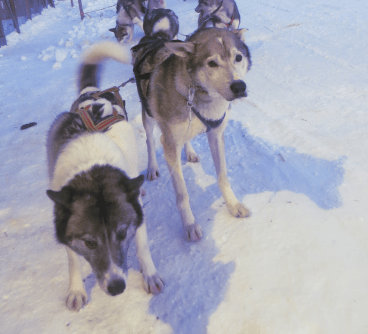
The dogs are either very intuitive, intelligent, trail-smart, strong, fast, tough or a combination of these qualities. It took very few commands to make the trip: “Gee!” means right, “Haw” means left, “Whoa” means stop. Lucy told us two other phrases that I’ve lost in translation but one means “Let’s get going!” and the other roughly means “Get up the hill” (getting up the hills was the only time I saw the dogs show any letting up on their breakneck speed; the tourists are getting heavier every year).
Lucy has no need to yell. The commands were more reminders than commands to the dogs who already seem to know their job well enough. Between musher and dog, it was a concise conversation so unlike the owners of city dogs who stand on their steps and yell for their wayward dog to quick digging in the neighbor’s garden and come home already.
Lucy explained there were two leaders, the young inexperienced dog and the older dog at the front, who had the brains. Behind them were the “swing dogs.” “Their job,” said Lucy, “was to catch any mistakes the leaders make and correct them.” Finally, the two dogs at the back, which included an eleven-year-old, were the “wheel dogs,” the heavy-lifters with the strength and endurance, and, also, most importantly, the calm demeanor to not be spooked by the sledge constantly threatening to run them over or the squeals and whoops of two women.
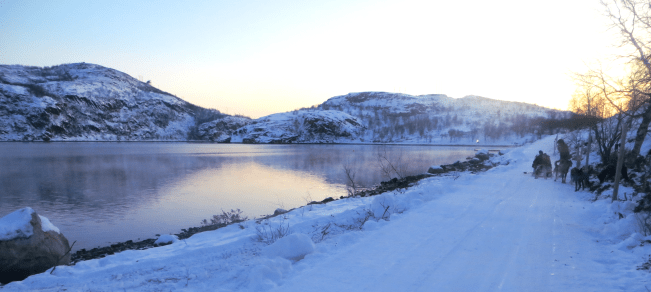
The ride was not limited to a safe circle like the pony rides for children at the State Fair. We raced up and over hills through the woods until we came to the openness of a frozen fjord (which, in a long winter, can have ice meters thick). This stretch was straight sprinting and the dogs looked like they wanted to run to the ocean and back. Lucy stopped more than once to let us take photos which involved the even more difficult maneuver of swinging a leg back over the sledge and standing up (Lucy was always there to lend a hand). With mittens off, the fingers went numb after a couple of shots; this was one of the coldest days so far. Lucy had to stay with the sledge or the dogs, so eager to keep going, would have run away with it.

At this time of year, this far above the Arctic Circle, I was told more than once that it is dark all day (which is the flip side of the Midnight Sun in the summer). But it is not dark. The Polar Light is a magical soft light of grays and blues and whites that feels more authentically Norwegian to me than the sunny days of summer. It is not quite twilight and not quite dawn; not an ending or a beginning. Instead it is other worldly and a step out of time. You quickly learn to appreciate not only the lack of sunlight but the lack of man-made light, sounds, and chaos. The Polar Light is gentle on the senses and the mind and demands reflection. For those who return saying they couldn’t see anything at this time of the year, were not looking or seeing.
After the flats of the fjord, we returned to the woods with some thrilling turns and reckless downhills with quick curves at the bottom where the runners scraped against the ice and Rita and I whooped. The only thing we really worried about was falling off—I felt on the verge of falling every moment which only added to the thrill—was the tumble we would take, bouncing into the snow like giant stuffed beach balls, landing on our back with our limbs waving in the air like flipped bugs. It would have taken a team of dogs to pull us up again.
It was a good long ride but too short, of course. I took more photos of the dogs than of any other iconic landmark in Norway. I thanked each of the dogs in the team and thought how well the team is put together. The two lead dogs, young and old, share the task, think, learn, and agree on decisions and direction (bipartisan, you could say).
I think, if I were a sled dog, I would be a wheel dog, the marathoners of the team, not fast but steadfast and resolute. They willingly carry the load whenever asked and will do so until they drop from exhaustion; better to drop than to quit.
The swing dogs are neither leaders nor followers but correct, without credit, the mistakes of the leaders for the good of the team. They are also responsible for pulling the sled safely around curves (avoiding high speed sled-tree contact).
Don’t we all need a swing dog or two at times in our lives? Someone to bring us safely around the curves that life throws us?

Four-time Iditarod winner, Susan Butcher said, “Dogs have a lot to communicate to a person willing to listen.”
There is as much to hear in the far north as there is to see.
(Coincidentally, I posted this on Susan Butcher’s birthday, Dec. 26, 1954. Sadly, she died of leukemia in 2006.)

 Journeys