
I sat on a bench in a warehouse-sized room watching a screen that covered one wall. On the screen the camera slowly zoomed in and then slowly pulled away from a wall of limestone bricks…and then zoomed in again. This installation (I feel I should use artsy vocabulary for this post) is called An Unknown Quantity by Zachary Formwalt. The brick walls hold up the stock exchange building in Amsterdam. The voice over, with the calmness and tone of an evil bad guy about to pull your teeth out, “links the complex presentation of the historical events with capitalism, politics, and imagination” (according to the handout I was given). The video lasted for 39 minutes. I did not stay for 39 minutes. I did give it maybe nine minutes of earnest appreciation (and it was nice to sit down after walking around Bergen for hours).
I was at the Bergen Kunsthall Museum, one of several museums that make up Art Row next to Lungegardsvann Lake (I can pronounce that better than you might think).
I tried to appreciate Nina Canell’s installation of “microchips and cucumbers” (synthetic but look like the real thing) “an apparently contradictory motif which nevertheless, in a similar way, exposes the inside of a corresponding compact and complex system consisting of a built-in code and information.” Well, if you put it that way, I do kind of get it. I like the name of the installation: Cucumbery. I’ll never look at cucumbers or microchips the same way again, which is probably the point and worth the visit.
Nina’s piece that I did develop some sympathy for looked like what electronic nerds save for parts, a small machine with dials and meters with tangled wires, some of which were tacked to the wall. Sporadically the contraption let out a squeal and the wires spasmed like a dying heart. I felt sorry for it.
Next door was one of the Kode museums featuring an exhibition of famous Norwegian artists including, of course, Edvard Munch. Room led to room intuitively and dark rooms were lit by a motion sensor making one feel quite special, as if the paintings were waiting just for you and happy to come out of the darkness.
You can look all you want at the masters in coffee table books or gallery reproductions, but there’s no equal to standing in front of a landscape the size of a ping pong table. Edvard Grieg is my people. He understands depression; he should, he checked himself into a sanitarium once. His landscapes are cold and wild and intimidating. His portraits know what it is to live in a northern climate where skin is pale, and expressions are as stoic and mysterious as flat drifts of snow, more melancholy than painful.
One of his nudes reminded me of me when I walked past the wall-sized mirror in my room last night, cellulite thighs, flabby arms, and sensuous (read bulging) belly. I want to thank Edvard for finding real women worth painting.
Munch’s brush strokes look deceptively simple, almost childish, but the expressions of his people are piercing.
Call me plebeian but I would rather gaze at Inger on the Beach than a cucumber anytime. Then Inger and I would go out for a kaffe to talk about cellulite thighs and flabby arms and waiting for men that leave you sitting on the shore.
Does everyone walk away from great paintings with the urge to paint?
That’s what I have my Surface Go for. 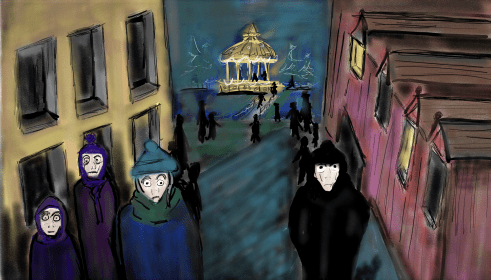
So, with apologies to Edvard (and every other painter who knows what he’s doing), and his Evening on Karl Johan Street, I scribbled with the passion of a kid with finger paints, Evening in Bergen (that’s me in the blue Helly Hansen coat).

 Journeys